Friendly-play note: Rummy traditions vary by region and table. Agree on house rules before the first deal. RummyPoints is a free scorekeeper and does not handle wagers.
01
The objective
Your goal is to arrange all 13 cards into valid sequences and sets before the other players. A winning hand normally needs at least two sequences, and at least one of those must be a pure sequence made without a joker.
The remaining cards can be arranged into additional sequences or sets. When every card belongs to a valid group, you may declare and show your hand for verification.
02
Set up the table
Shuffle the agreed number of decks with printed jokers, deal 13 cards to each player, place the remaining cards face down as the closed pile, and turn one card face up to begin the discard pile. Select a wild joker for the deal if your group uses one.
- Agree on the format: Points, Pool 101, Pool 201, or a fixed number of deals.
- Confirm drop, joker, ace, and invalid-declaration rules before the first deal.
- Choose who deals first and the direction of play.
03
Take a turn
On your turn, draw one card from either the closed pile or the top of the discard pile. Then discard one card so that you return to 13 cards. Continue drawing, grouping, and discarding until someone is ready to declare.
Draw 7♥ from the closed pile, use it with 5♥ and 6♥, then discard a card that does not improve your hand.
04
Build sequences and sets
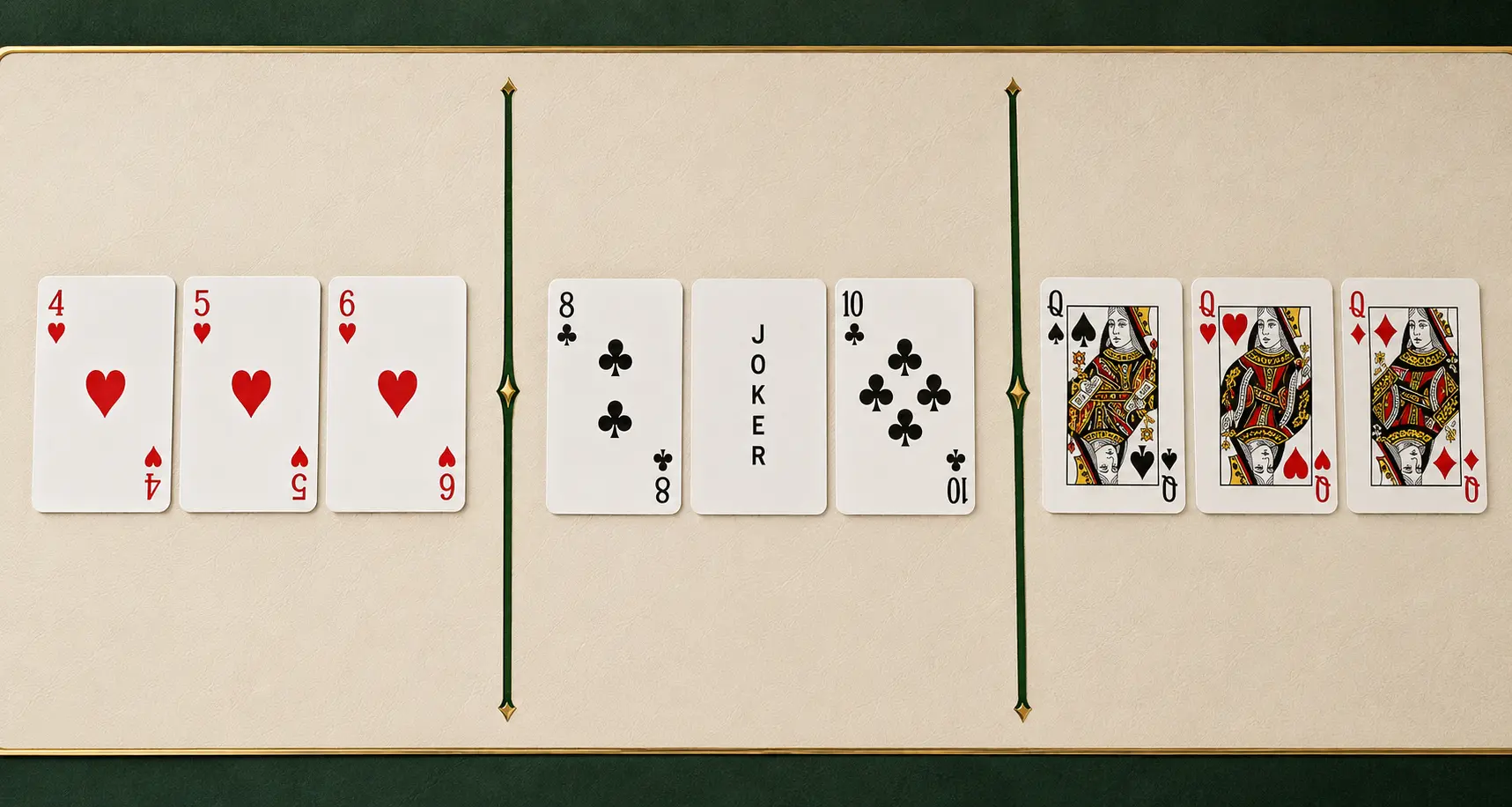
A sequence contains three or more consecutive cards of the same suit. A pure sequence uses no joker. An impure sequence uses a printed or wild joker as a substitute. A set normally contains three or four cards of the same rank in different suits.
- Pure sequence: 4♣–5♣–6♣
- Impure sequence: 9♦–10♦–Joker–Q♦
- Set: 8♣–8♦–8♥
- Invalid sequence: 5♣–6♦–7♣ because the suits do not match
05
Declare and score
After arranging all 13 cards, discard according to your house procedure and declare. The hand is checked for the required pure sequence, second sequence, and valid remaining groups. A valid declarer scores zero for the deal. Other players total the cards that are not protected by valid groups, subject to the agreed maximum.
FAQ
Common questions
Do I need two pure sequences?+
Usually no. You need at least two sequences in total, with at least one pure sequence. The second may be pure or impure.
Can an ace be high or low?+
Common rules allow A-2-3 and Q-K-A, but not K-A-2. Confirm the convention before playing.
Can two players use the same card?+
No. Every physical card belongs to only one player's hand or one of the table piles.