
Friendly-play note: Rummy traditions vary by region and table. Agree on house rules before the first deal. RummyPoints is a free scorekeeper and does not handle wagers.
01
The winning-hand rule
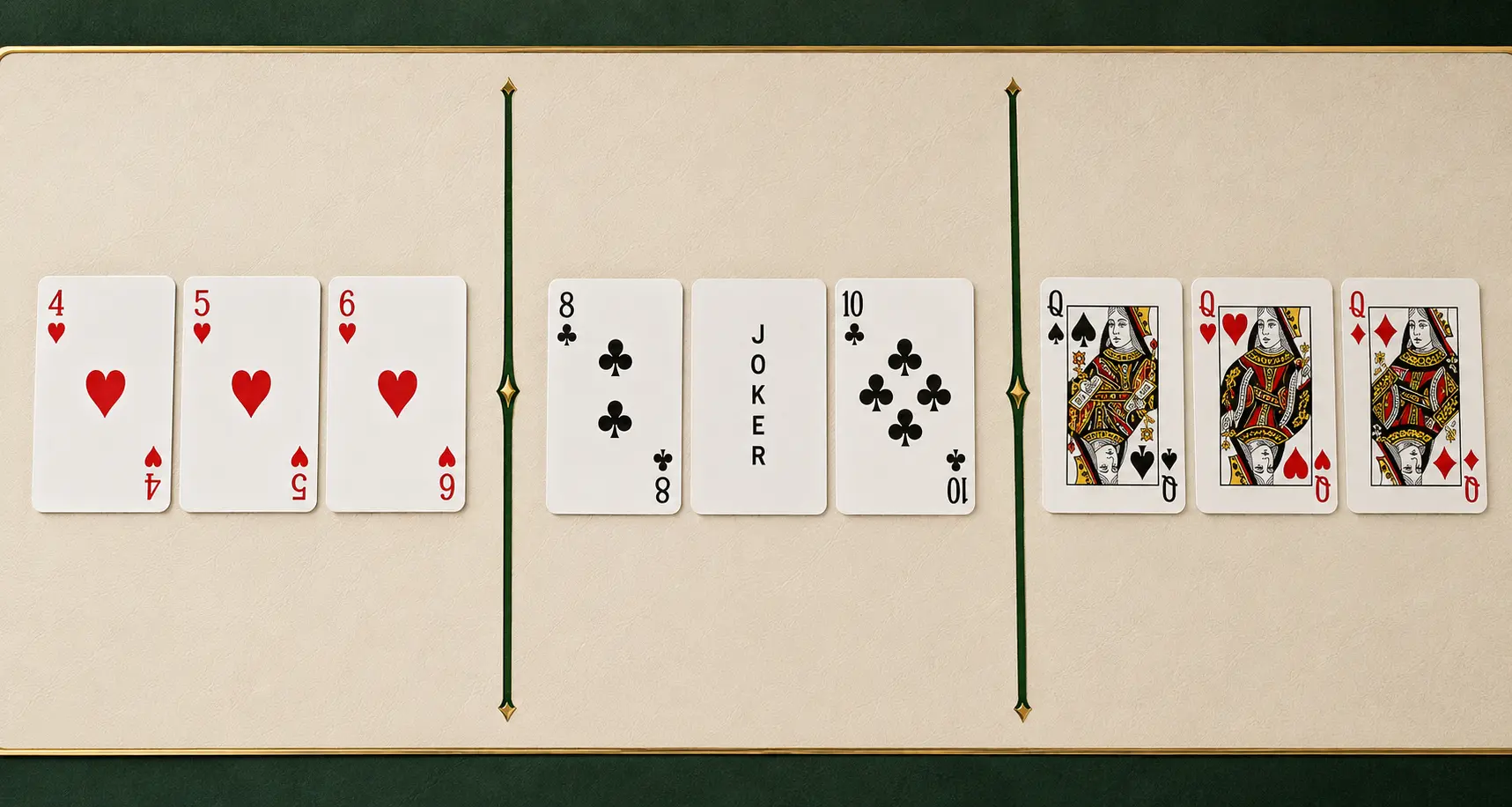
A standard 13-card Indian Rummy declaration is valid when all cards are arranged into sequences and sets, there are at least two sequences, and at least one sequence is pure. Cards that do not belong to a valid group make the declaration invalid.
02
Pure and impure sequences
A pure sequence is three or more consecutive cards of one suit without using a joker as a substitute. A natural card that has also been selected as the wild-joker rank may usually be used in its natural place; agree on this detail before play. An impure sequence contains a joker substituting for a missing card.
7♠–8♠–9♠ is pure. 7♠–Joker–9♠ is impure.
03
Valid sets
A set contains three or four cards of the same rank. The natural cards should normally be from different suits. Jokers may be used to complete a set, but table conventions can differ when multiple decks create duplicate cards.
- Valid: K♣–K♦–K♥
- Valid with joker: 4♣–4♥–Joker
- Usually invalid: 9♣–9♣–9♦ when duplicate suits are not allowed
04
Jokers
Printed jokers and the selected wild-joker rank can replace missing cards in impure sequences and sets. Jokers normally carry zero penalty points. They cannot replace the need for a pure sequence.
05
Drops and invalid declarations
Many groups assign a fixed penalty when a player leaves a deal before finishing, often distinguishing an initial drop from a middle drop. An invalid declaration commonly receives the maximum deal penalty. These values are house rules, so record them before the game begins instead of arguing after a declaration.
- Choose initial-drop points.
- Choose middle-drop points.
- Choose the maximum hand penalty.
- Decide whether a disconnected or absent player receives a drop or full penalty.
FAQ
Common questions
Is a set required to win?+
Not always. If all 13 cards can be arranged into valid sequences and the pure-sequence requirement is met, a separate set may not be necessary.
Is K-A-2 a valid sequence?+
No under common Indian Rummy rules. Ace may be low in A-2-3 or high in Q-K-A, but it does not wrap around.
Do house rules matter?+
Yes. Drop values, re-entry, duplicate-card sets, maximum penalties, and dealing procedures vary. Agree on them before play.