
Friendly-play note: Rummy traditions vary by region and table. Agree on house rules before the first deal. RummyPoints is a free scorekeeper and does not handle wagers.
01
The simplest difference
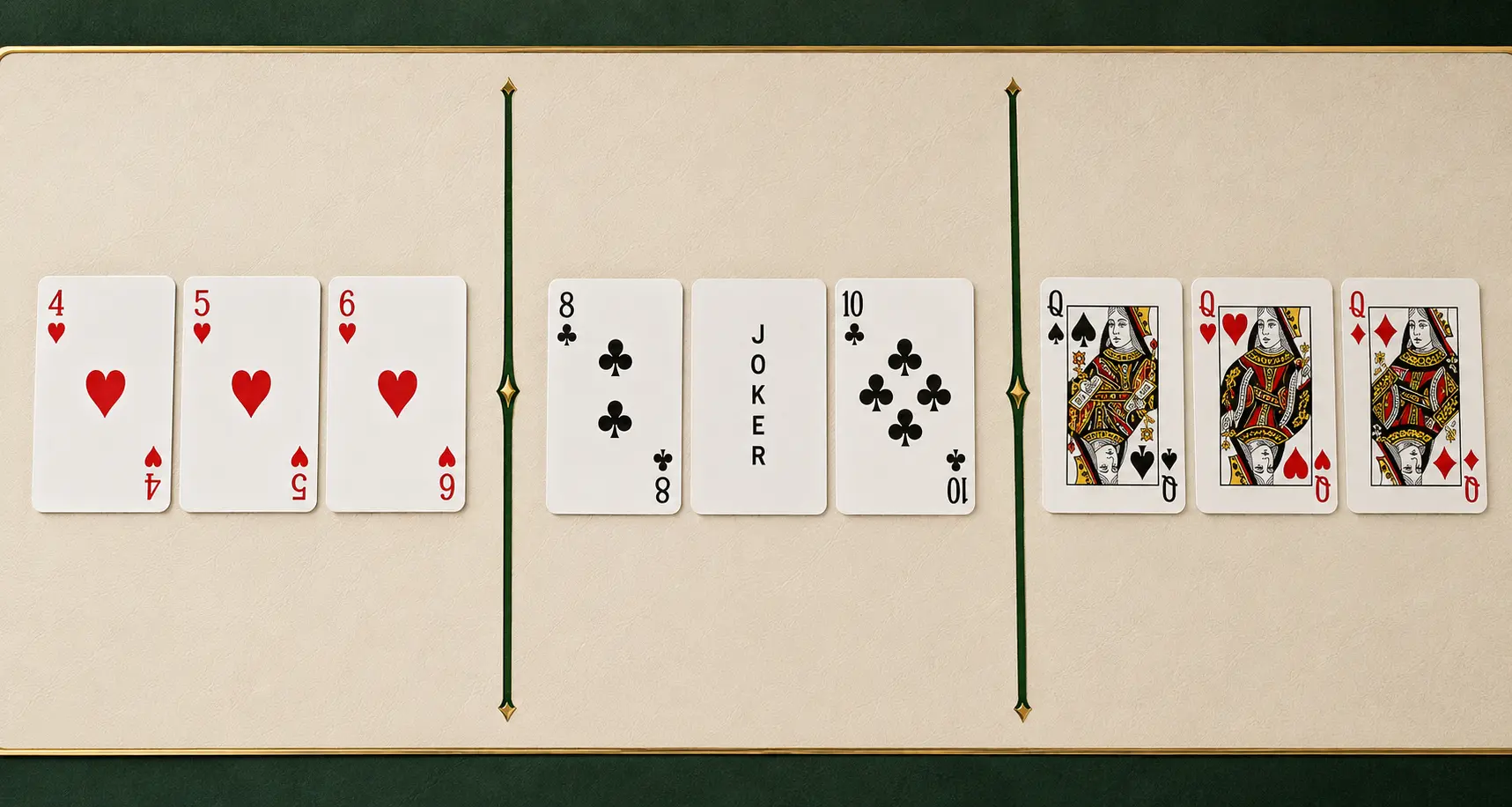
A sequence follows consecutive ranks within one suit. A set groups equal ranks from different suits. Both can organize a hand, but only a qualifying sequence satisfies the pure-sequence requirement.
6♠–7♠–8♠ is a sequence. 6♠–6♥–6♦ is a set.
02
Pure sequence
A pure sequence contains at least three consecutive cards from the same suit with no joker substituting for a missing rank. Standard 13-card Indian Rummy normally requires at least one pure sequence.
- A♣–2♣–3♣
- 9♦–10♦–J♦
- Q♥–K♥–A♥
03
Impure sequence
An impure sequence uses a printed or wild joker for a missing card. It can count as the second required sequence but cannot replace the required pure one.
10♣–Joker–Q♣–K♣ is an impure sequence.
04
Valid set
A set normally contains three or four cards with the same rank and different suits. A joker may replace one missing natural card. Duplicate-suit rules can vary when several decks are used.
- 3♣–3♦–3♥
- K♣–K♦–K♥–K♠
- 9♣–9♥–Joker
05
Fast validation checklist
Check groups in this order: find the pure sequence, find a second sequence, validate remaining sequences and sets, then confirm that all 13 cards are used exactly once.
- Same suit and consecutive ranks for sequences
- Same rank and usually different suits for sets
- At least one sequence without a substitute joker
- No loose or duplicated card
FAQ
Common questions
Is a set required to declare?+
Not always. A hand made entirely of valid sequences can declare if it meets the two-sequence and pure-sequence requirements.
Can a sequence contain different suits?+
No. Natural cards in a sequence must have the same suit.
Can a set contain five cards?+
A natural rank has four suits, so sets normally contain three or four cards.